This Pieta Is the Only Work of Art That Michelangelo Every Signed
Michelangelo's Pieta is the starting time and last fine art piece that the famous creative person ever signed. Only why did Michelangelo just sign the Pieta?
An Italian art historian of the catamenia, Giorgio Vasari, claims that Michelangelo signed his sculpture later overhearing a visitor giving credit to a rival artist. But later spontaneously signing the work, he regretted it and swore never to sign any of his works ever again.
Nonetheless, other art historians argue that his decision to sign the Pieta later on wasn't a spontaneous human action at all. Instead, they believe that the signature was planned before the artwork was always displayed.
No matter the truth, the signature shows that Michelangelo's Pieta was unique to him, and getting credit for it was important to him, at least in the moment.
Go on reading to get the full story of Michelangelo's signature on one of the nearly famous sculptures in the world.
(This article may contain chapter links. This means if you click on an affiliate link and make a purchase, I will receive a commission at no actress cost to yous)
Who was Michelangelo?
Michelangelo (1475-1564) was a sculptor, painter, builder, and poet in Renaissance Italy. He is considered one of mankind's greatest artists and has created numerous famous works of art.
Although Michelangelo is famous for his painting on the ceiling of the Sistine Chapel, he is even improve known for his incredible sculptures. You are probably very familiar with his Statue of David, but information technology was actually Michelangelo'due south Pieta, that started his career on an upward trajectory.
Michelangelo's Pieta Sculpture
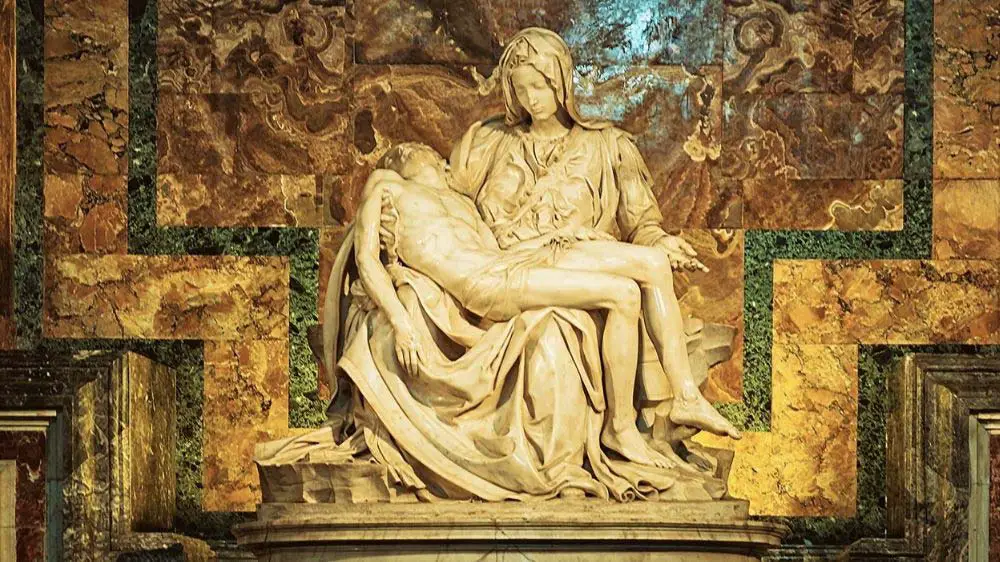
The Pieta was made in 1498-1499 by Michelangelo and is 68.5 × 76.8 inches in size. Michelangelo's Pieta is a marble sculpture depicting the Virgin Mary holding Jesus' body in her lap.
The sculpture has a pyramidal structure with Mary'southward head on the superlative corner. Mary's dress widens, creating the pyramidal construction to the base, representing the Rock of Calvary (aka Golgotha, the site of Jesus' crucifixion). Jesus is represented with a serene facial expression and the marks from his crucifixion are visible on his palms and stomach.
Michelangelo's Pieta is his first art piece in a series of sculptures following the same theme – a crucified Jesus in the artillery of a grieving Mary. These kinds of sculptures are all called "Pieta," which is Italian for "pity" or "compassion."
The Pieta is 1 of iii ways that a sorrowful Virgin Mary is frequently portrayed. Michelangelo'due south Pieta is carved from marble making information technology unlike from other Pieta sculptures. Earlier Pieta statues were commonly much smaller and carved from wood.
History Backside Michelangelo's Pieta
The Pieta statue was commissioned past the French Fundamental Jean de Bilhères equally a funeral monument for himself.
But the Cardinal died on August 6, 1499, earlier the sculpture could be completed. Although the Cardinal never saw Michelangelo'due south Pieta, the famous sculpture was still placed in the Chapel of Santa Petronilla as a funeral monument for the Cardinal until it was moved in the 18th century to St. Peter'south Basilica in Vatican City.
Michelangelo's Pieta is the only slice fabricated past a famous Renaissance creative person to exist installed in St. Peter'due south Basilica and accepted past the Chapter of St. Peter.
Michelangelo'southward Pietra was inspired past the art of the Alps and the Germanic sculpture group, the Vesperbilder.
Michelangelo'southward Pieta and The Virgin Mary
Something else that makes Michelangelo'due south Pieta different from other Pieta statues is his take on a youthful Virgin Mary. She is portrayed as unusually youthful and more peaceful than the older, sorrowing Mary that most Pieta's show. Michelangelo had two reasons for portraying her in this youthful way:
- Since all beauty comes from God, and Mary is closely connected to the holy spirit, Michelangelo wanted her to be portrayed equally immature and beautiful.
- Since the Virgin Mary is considered to be a moral and beautiful person on the inside, information technology was important to him that she reflected that beauty on the exterior.
Something else that sets this Pieta apart from Michelangelo'due south other Pieta sculptures is the office of the Virgin Mary. She is alone, grieving and holding Jesus' torso in her lap.
In Michelangelo's bottom-known Pieta called The Degradation (1547-1555), the Virgin Mary is not holding Jesus' torso alone, just instead is existence helped by Nicodemus and Mary Magdelene.
Michelangelo's Pieta Signature
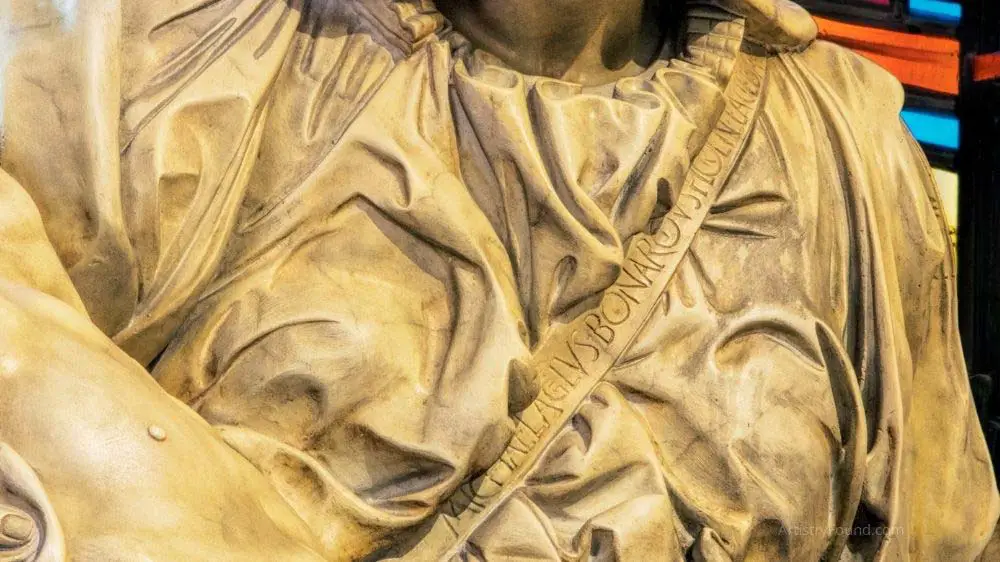
However, the near important detail that makes this sculpture stand out from Michelangelo's other works is that this Pieta contains his signature. Michelangelo never signed any of his other artistic works making this Pieta extremely unique.
So, out of all his works, why did Michelangelo only sign this Pieta?
The well-nigh widespread story of why Michelangelo signed this Pieta originates from a biography of Michelangelo fabricated by the famous Italian artist and historian Giorgio Vasari (1511-1574).
According to Vasari, Michelangelo had overheard visitors thinking that rival creative person Christoforo Solari had made the sculpture. So, in a spontaneous act, Michelangelo took his hammer and chisel and scrawled:
"MICHAELA[Due north]GELUS BONAROTUS FLORENTIN[US] FACIEBA[T]"
which translates to
"Michelangelo Buonarroti, Florentine, made this"
This signature was chiseled into the sash beyond Mary's chest. Vasari reports that Michelangelo regretted his impulsive and prideful decision and was determined never to sign a piece of his work again.
Simply others claim that Michelangelo's signature was not a spontaneous outburst like Vasari reports. Associate fine art curator, Aileen June Wang, published an commodity in 2004, claiming that Michelangelo's signature was carefully planned. Wang states that Michelangelo's signature was a deliberate motility to increase his reputation and overall image every bit an artist.
Wang claims in her research that the band across the chest of the Virgin Mary serves no other purpose than holding Michelangelo's signature.
Also, his signature manner looks more like it was advisedly carved than written as an afterthought, simply like his choice of wording.
Michelangelo used an aboriginal Greek imperfect verb tense, suggesting that much thought was put into information technology. She believes that the deliberate separation of Michelangelo'southward name emphasizes his self-perception as a creator conveying God'southward bulletin.
These details brand Wang believe that the story backside Michelangelo's signature has more to it than what Vasari has accounted for.
Even though we lack the whole truth, there is ane matter we do know: This was the only time that Michelangelo ever signed any of his works. Then in that manner, Michelangelo'due south Pieta is unique.
The Effect of Michelangelo's Famous Pieta
Not simply was Michelangelo'south Pieta his starting time commissioned artwork, merely it is now one of the most valuable art pieces in the world today. He was just 24 years old when he created the slice, and the sculpture set the tone for the remainder of his long and successful career.
Although Michelangelo's Pieta has gotten a lot of positive attention throughout the years, it has also had its critics.
In 1972 Michelangelo's sculpture was attacked by a man wielding a hammer. The man rained down 12 damaging blows before being stopped. Since that fourth dimension, Pieta has been surrounded by protective, bulletproof glass. Unfortunately, the sculpture was also damaged when movers accidentally broke off four of Mary's fingers. However, all of the harm from both cases has been restored.
Aside from these incidents, Michelangelo's Pieta hasinspired faith, emotion, and imitation through its unique depiction of Jesus Christ and the Virgin Mary.Many people seek to be in its presence for both creative and spiritual reasons.
The slice itself is not fully renaissance nor entirely classical in its form; Michelangelo managed to blend the two art styles. In add-on, he didn't use realistic proportions when sculpting the piece, giving the viewer a more artistic and more than accessible interpretation of this scene.
When Did Artists Start Signing Their Artwork?
Prior to the renaissance and Michelangelo'southward fourth dimension, it was not common for artists to sign their work. And so it is non surprising that Michelangelo didn't add signatures to his artwork.
Sophilos was the get-go known artist to sign his artwork. He added "Sophilos painted me" (Sophilos me grafsen) on pottery that he painted in 590-570 BC.
Only the ongoing tendency of signing i's artwork didn't first until the Renaissance period and nigh likely had just started to gain popularity around the time of Michelangelo's career.
The trend, nevertheless, began to ensure that artists were credited for their work. In improver, an creative person's signature proved to be helpful to viewers and collectors of artwork to make up one's mind cosmos date and authenticity. Finally, artists like Picasso began to employ their signatures to limited inventiveness and to show transformation as an artist at times where he changed his signature.
Conclusion
No wonder Michelangelo's Pieta has gained and then much attention; I mean, the sculpture itself is a masterpiece. I would understand why Michelangelo would want to marker this slice every bit his ain and not have information technology accredited to someone else.
Even if his signature wasn't a spontaneous afterthought, the fact that he never signed any of hisother works makes his signature on Pieta special.
More From Artistry Found
- What Are The Cheapest Picasso Paintings (Revealed!)
- How Much Are Patrick Nagel Pictures Worth?
- 5 Reasons Why Van Gogh is Famous (And Deserves To Be!)
- The 4 Most Famous Anthropomorphic Artists in History
Source: https://artistryfound.com/michelangelos-pieta-signature/
0 Response to "This Pieta Is the Only Work of Art That Michelangelo Every Signed"
Post a Comment