True or False Deaf Themed Art Is the Same as Deãƒâ¢ via Art True False
Deaf culture Introduction
Deaf culture is the set of social beliefs, behaviors, fine art, literary traditions, history, values, and shared institutions of communities that are influenced by deafness and which use sign languages every bit the main means of communication. When used as a cultural label peculiarly inside the culture, the word deaf is often written with a capital D and referred to as "big D Deaf" in speech and sign. When used every bit a label for the audiological condition, it is written with a lower case d.[1] [2] Carl Yard. Croneberg coined the term "Deaf Culture" and he was the first to discuss analogies between Deaf and hearing cultures in his appendices C/D of the 1965 Dictionary of American Sign Language.[3]
Background [edit]
Members of the Deafened community tend to view deafness equally a difference in human experience rather than a disability or illness.[4] [5] [half dozen] [seven] Many members have pride in their Deaf identity.[viii] [9] Deaf people, in the sense of a community or culture, can and then be seen every bit a linguistic minority, and therefore some who are a part of this community may experience misunderstood by those who don't know sign language. Another struggle that the Deafened community oft faces is that educational institutions usually consist primarily of hearing people. Additionally, hearing family members may need to learn sign language in order for the deaf person to experience included and supported. Unlike some other cultures, a deaf person may join the customs afterwards in life, rather than needing to be born into it.[10]
Three views on Deaf people
There are several perspectives on deaf people and Deaf civilisation that shape their treatment and role in society. From a medical standpoint, many encourage Deafened children to undergo surgery. Specially in the past, the medical perspective discouraged the utilise of sign language because they believed information technology would distract from development of auditory and speech skills. From a social standpoint, Deaf individuals are welcomed to participate in club in the same fashion as any other individual. This view discourages the idea that those who are deaf or hard-of-hearing are ill and in demand of a cure. The social view as well encourages making accommodations for deaf people and then that they tin fully participate in society. Such accommodations include the apply of interpreters or improved closed captioning systems. Many experience, however, that the social view fails to recognize the unique qualities of Deaf people and Deaf culture. They believe that this perspective asks Deafened people to fit and notice their own way in a predominantly hearing lodge, instead of recognizing their ain abilities and culture. Some other perspective is referred to as the cultural-linguistic view. Supporters of Deaf Civilisation state that this perspective appropriately recognizes Deafened people every bit a minority culture in the earth with their own language and social norms. This standpoint is believed to promote Deafened people'southward right to collective space within gild to pass on their linguistic communication and culture to future generations.[xi] [12]
Being involved in the Deaf community and culturally identifying as Deaf has been shown to significantly contribute to positive self-esteem in Deaf individuals.[13] The community tin can provide back up, piece of cake social interaction, and "refuge from the grinding frustrations of the hearing earth." Conversely, Deaf individuals who are not a part of the Deafened customs may not have the same support in the hearing world, resulting in lower self-esteem.[14] Stereotypes, lack of cognition, and negative attitudes about Deafness cause widespread discrimination.[13] This could lead to a lower didactics and economic status for deaf people.
The community may include hearing family unit members of deaf people and sign-language interpreters who identify with Deafened civilisation. It does not automatically include all people who are deaf or hard-of-hearing.[15] Equally educator and American Sign Language interpreter Anna Mindess writes, "it is non the extent of hearing loss that defines a member of the deaf community but the individual's own sense of identity and resultant actions."[16] As with all social groups that a person chooses to vest to, a person is a member of the Deaf community if they place equally a member of the community and the community take them as a member of the community.[17]
Deaf culture is recognized under Article 30, Paragraph 4 of the United Nations Convention on the Rights of Persons with Disabilities, which states that "Persons with disabilities shall be entitled, on an equal basis with others, to recognition and support of their specific cultural and linguistic identity, including sign languages and deaf culture."
Deaf civilisation is as well recognized in the argument presented at the 21st International Briefing on Education of the Deaf in 2010 in Vancouver, Canada, where the more than than 60 countries that participated in it agreed that "Despite this 'disability mindset,' Deaf citizens positively contribute to societies that comprehend diverseness and creativity. They heighten their nations in areas of teaching, economic activity, politics, arts and literature. For Deaf people, It is an inalienable right to exist acknowledged as a linguistic and cultural minority integral to every society."[eighteen] [19]
In Deaf culture, "sumain" refers to people who communicate with each other using their hands.[xx] Marla Berkowitz, a Certified Deaf ASL interpreter, describes it equally "a coined word from two languages – Su – your; main – hands".[20]
Acculturation [edit]

Merikartano school for deaf students in Oulu, Finland (February 2006)
Acquisition of Deaf Culture

Students at a schoolhouse for deaf students in Baghdad, Iraq (Apr 2004)
Historically, acculturation has often occurred inside schools for Deafened students and within Deaf social clubs, both of which unite deaf people into communities with which they can identify.[4] Condign Deaf culturally can occur at unlike times for dissimilar people, depending on the circumstances of one'due south life. A small proportion of deaf individuals acquire sign language and Deafened civilisation in infancy from Deafened parents, others acquire it through attendance at schools, and however others may not be exposed to sign language and Deaf culture until college or a time after that.[16]
Although upwardly to 50 percent of deafness has genetic causes, fewer than five per centum of deaf people have a deaf parent,[21] so Deaf communities are unusual amidst cultural groups in that nigh members practice not acquire their cultural identities from parents.[22]
Diversity within Deafened culture [edit]
Educator and ASL interpreter Anna Mindess notes that in that location is "not just ane homogeneous deaf culture".[sixteen] In that location are many singled-out Deafened communities around the earth, which communicate using different sign languages and exhibit dissimilar cultural norms. Deaf identity also intersects with other kinds of cultural identity. Deaf culture intersects with nationality, education, race, ethnicity, gender, class, sexual orientation, and other identity markers, leading to a culture that is at once quite small-scale and also tremendously various. The extent to which people identify primarily with their deaf identity rather than their membership in other intersecting cultural groups also varies. Mindess notes a 1989 study,[ where? ] which establish that "87 percent of black deaf people polled identified with their black culture offset".[xvi]
Didactics [edit]
Deaf culture is prevalent in schools for the deaf. There are K–12 schools for the deaf throughout the world, however college pedagogy specifically for the deaf is more express.
Abbé Charles-Michel de l'Épée opened the first school for the deaf in Paris at the deaf school. The American Thomas Gallaudet witnessed a sit-in of deaf teaching skills from Épée's successor Abbé Sicard and two of the schoolhouse's deaf faculty members, Laurent Clerc and Jean Massieu; accompanied by Clerc, he returned to the United States, where in 1817 they founded American School for the Deafened in Hartford, Connecticut. American Sign Linguistic communication (ASL) started to evolve from primarily French Sign Language (LSF), and other outside influences.[23]
In a residential school where all the children use the same advice system (whether it is a school using sign linguistic communication, Total Advice or Oralism), students will be able to interact normally with other students, without having to worry about beingness criticized. An statement supporting inclusion, on the other hand, exposes the student to people who are non just like them, preparing them for adult life. Through interacting, children with hearing disabilities can expose themselves to other cultures which in the future may be benign for them when it comes to finding jobs and living on their own in a lodge where their disability may put them in the minority. These are some reasons why a person may or may non want to put their child in an inclusion classroom.[24]
United States [edit]
In comparison to the full general public, deaf people have lower levels of educational achievement.[25] Advocates in deafened education believe that an improved recognition of American Sign Language (ASL) as an official language would improve education, every bit well as economic condition. Some argue that by improving the recognition of ASL, better admission to schoolhouse materials, deafened teachers, interpreters, and video-telephone communication would accept place.[26]
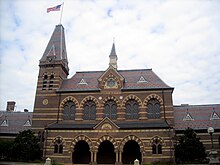
Gallaudet University'due south Chapel Hall
Iii colleges within the United States are often identified as the best providers of college teaching for deaf people.[ co-ordinate to whom? ] Referred to oft as the "Big Iii," these include California State University at Northridge (CSUN), National Technical Institute for the Deaf (part of Rochester Found of Technology), and Gallaudet University. Gallaudet Academy is the first and only liberal-arts higher for deaf students in the earth.[27]

Those who are deaf (by either state or federal standards) have access to a free and advisable public education. If a child does qualify as being deaf or hard of hearing and receives an individualized pedagogy plan, the IEP team must consider "the child'southward language and advice needs. The IEP must include opportunities for direct communication with peers and professionals. Information technology must likewise include the educatee'due south academic level, and finally must include the students total range of needs"[28] [24]
In office, the Department of Education defines deafness every bit "a hearing harm that is and then severe that the kid is impaired in processing linguistic information through hearing, with or without amplification". Hearing impairment is defined as "an impairment in hearing, whether permanent or fluctuating, that adversely affects a kid's educational operation simply that is not included under the definition of deafness".[29]
Other countries [edit]
Although the Usa leads in college education opportunities for the deaf,[ according to whom? ] in that location are colleges beyond the earth. Brazil has several institutions, including Instituto Santa Tersinha and Escola para Crianças Surdas Rio Branco. Red china'due south deaf universities include Beijing Union University, Special Education College of Beijing University, and Zhongzhou Academy. Other notable universities for the deaf across the globe include Finland School for the Deaf in Republic of finland, Institut National de Jeunes Sourds de Paris in French republic, Berlin School for the Deaf in Germany, and Northwest Secondary Schoolhouse for the Deaf in South Africa.[xxx]
Characteristics [edit]
Sign language is just one part of deaf civilization. Deaf identity is also constructed around specific beliefs, values and art.
Sign languages [edit]

Sign languages are an of import part of Deafened culture. The American Sign Language (ASL) alphabet is shown here.

The sign for "friend" in American Sign Language
Members of Deaf cultures communicate via sign languages. Sign languages convey meaning through transmission advice and body language instead of acoustically conveyed sound patterns. This involves the simultaneous combination of hand shapes, orientation and movement of the hands, arms or body, and facial expressions to express a speaker'southward thoughts. "Sign languages are based on the thought that vision is the most useful tool a deafened person has to communicate and receive information".[31]
At that place are over 200 distinct sign languages in the globe. These include 114 sign languages listed in the Ethnologue database and 157 more than sign languages, systems, and dialects.[32] [33] While the United Kingdom and the United States are both predominantly English language speaking, the predominant signed languages used in these countries differ markedly. Due to the origins of deafened education in the United states of america, American Sign Language is most closely related to French Sign Language.
Values and beliefs [edit]
- A positive attitude towards deafness is typical in Deafened cultural groups. Deafness is not generally considered a condition that needs to exist fixed.[16]
- The term "Deafened Gain" is used by Deaf people, to re-frame the perceived losses of Deafness and "hearing loss" to highlight the benefits of being deafened. According to deaf scientist Michele Cooke, it describes the benefits that Deafened people provide the larger community.[34]
- Culturally, Deaf people value the use of natural sign languages that exhibit their own grammatical conventions, such as American Sign Language and British Sign Language, over signed versions of English or other oral languages. Spoken English, written English and signed English are three dissimilar symbolic systems for expressing the same language.[35]
- Deaf communities strongly oppose bigotry against deaf people.
- Deaf culture in the United States tends to be collectivist rather than individualist; culturally Deaf people value the grouping.[16]
- The apply of a sign language is central to Deaf cultural identity. Oralist approaches to educating deaf children thereby pose a threat to the continued existence of Deafened civilization. Some members of Deafened communities may likewise oppose technological innovations like cochlear implants for the same reason.
Cochlear implants [edit]
A cochlear implant is not to be mistaken for a hearing aid, which makes noises and sounds louder for the user to hear. Instead, cochlear implants featherbed the outer ear and target the inner ear where the auditory nervus fibers are stimulated.[36] To exercise this, noises and sounds are transformed into electrical energy which is translated as audio information by the nerve which is and so sent to the encephalon.[37] An external microphone captures outside sound, a transmitter processes these sounds and sends them to a receiver embedded nether the skin in the skull, and the receiver transforms these sounds into electric impulses which stimulate the auditory nerve.[38]

Cochlear Implant: A surgically implanted device used by Deaf and hard-of-hearing individuals to experience representations of sound[37]
The medical model of disability can be aligned with technological advancements in cochlear implants. This is due to the fact that cochlear implants can be perceived to "cure" deafness or gear up an private's hearing,[39] when in reality those who are Deaf may not experience a demand to exist cured or fixed. This idea is seen in many children'south books, where improved quality of life is just seen after characters obtain cochlear implants.[xl] This idea that deafness is a physiological upshot that resides only within the individual and therefore should be physiologically fixed or solved counters the teachings and beliefs inside Deafened culture.[37] Often people feel as though children should make the decision if they want a cochlear implant for themselves every bit opposed to someone else, like their parents or caregivers, making it for them. Although ethical, this idea poses a trouble since the success rate of cochlear implants is at its highest when implanted at early childhood;[41] in other words, when the child is not able to brand rather large decisions, like this one, for themselves.[forty] These critics argue forcing cochlear implants on children should be reduced and the assumption that cochlear implants offering the best quality of life for Deaf individuals should be countered. I manner of doing this would be to expose children of young ages to Deaf civilization and the Deaf community early on, equally well as teach them American Sign Language.[37]
Cochlear implants accept been controversial effectually the Deaf community ever since they first were made available to the public.[xl] Those who oppose cochlear implants fifty-fifty refer to it every bit "cultural genocide," as information technology lessens the prevalence and importance of Deaf civilisation.[42] [37] People are against cochlear implants for a diversity of reasons, including: there is value to being Deafened, being Deafened is not an illness and does not require a cure, the Deaf are not lesser than the hearing, etc. Cochlear implants also have a diversity of risks associated with them, like costliness, effectiveness, and surgical requirement. Alternative solutions proposed by cochlear opponents are centered around the social model of inability, where instead of fixing the bodily hearing of the individual, reform and accommodations can be made in guild, didactics, and more to better permit the individual to exist integrated into society equally would any other.[37]
Alternatively, those who support cochlear implants do non necessarily oppose Deaf civilisation. Culture itself is not a simple concept, but rather information technology has high levels of complexity and power; due to this nature, civilization is not to be applied narrowly to a group of individuals. The Deaf community is equanimous of highly diverse Deaf individuals, and to impose narrow culture onto a group full of heterogeneous members would be rather questionable.[41] At that place is room for deviation and hybridization of values and beliefs in Deafened culture as society and engineering science evolves. Even if they are proud of their Deaf identity, many deaf individuals wish they knew what their voices sounded like, and wish they could option up the phone and have a conversation with ease without the need for a third-party device or interpreter.[41] And so, instead of looking at cochlear implants as identity stripping, many Deafened parents of Deaf children see cochlear implants every bit a way to requite their children more than what they have; to offering them the pleasance of being able to hear.[41] It has as well been proven that cochlear implants help to provide opportunities for success, and help individuals to feel more continued to the world. Though most Deafened individuals concord that choosing to employ a cochlear implant is a difficult decision, many say that resistance to cochlear implants has decreased since 1990, the year when it was offset approved for children. By building more evidence of the benefits and limitations of cochlear implants, both Deaf and hearing individuals can exist properly educated on the touch of cochlear implants, and thus unrealistic expectations and controversies can be resolved.[43]
Behavioral patterns [edit]
- Culturally Deaf people have rules of etiquette for getting attention, walking through signed conversations, get out-taking, and otherwise politely negotiating a signing surround.
- Deaf people also continue each other informed of what is going on in one's environs. Information technology is common to provide detailed information when leaving early or arriving tardily; withholding such information may be considered rude.[16]
- Deafened people may be more than straight or blunt than their hearing counterparts.[xvi]
- When giving introductions, Deaf people typically endeavor to discover common ground; since the Deaf community is relatively small, Deaf people commonly take other Deaf people in mutual.[16]
- Deaf people may also consider time differently. Showing upwards early to large-calibration events, such as lectures, is typical. This may be motivated by the need to get a seat that provides the all-time visual clarity for the Deaf person.
Importance of technology [edit]
- Like all other people, Deafened individuals rely on technology for communication significantly. In the United States, video relay services and an array of freestanding and software-driven video phones are ofttimes used by deaf people to conduct telephonic advice with hearing and deaf businesses, family and friends. Devices such as the teletype (known as a TTY, an electronic device used for communication over a telephone line) are far less common, just are used by some deaf people who are without admission to high-speed Internet or have a preference for these methods for their telephonic advice.
- Technology is fifty-fifty important in face-to-confront social situations. For example, when deaf people see a hearing person who does non know sign language, they oft communicate via the notepad on their prison cell phones. Here, applied science takes the place of a human sense, allowing deafened individuals to successfully communicate with dissimilar cultures.
- Social media tends to be of great importance to deafened individuals. Networking sites allow deaf people to find each other and to remain in contact. Many deaf people have deaf friends throughout the entire country that they met or maintain contact with through online communities. Because the deafened community is and then pocket-size, for many deafened people, the stigma of meeting others online does non be.
- Closed Captioning must be available on a television in social club for a deaf person to fully appreciate the audio portion of the broadcast. Conflicts arise when establishments such as restaurants, airlines, or fettle centers neglect to accommodate deaf people by turning on Closed Captioning. Picture theaters are increasingly compliant with providing visual access to outset-run movies through stand-alone devices, glasses and open caption technology which allow deaf people to attend movies every bit they are released.[44]
- Alert systems such as burn alarms and alarm clocks must appeal to different senses in gild for a deaf private to notice the alert. Objects such equally vibrating pillows and flashing lights often take the place of the noise-based alarms.
- Lack of understanding about technological accessibility for the deafened causes conflict and injustice for the deafened customs. For case, a significant number of deaf individuals in the United kingdom of great britain and northern ireland admit that they are dissatisfied with their banks because of their heavy reliance on telephone banking and lack of assistance to deafened and hard-of-hearing individuals.[45]
- Compages that is conducive to signed communication minimizes visual obstructions and may include such things as automatic sliding doors to free up the hands for continuous conversation.[46]
Literary traditions and the arts [edit]
A strong tradition of poetry and storytelling exists in American Sign Language and other sign languages. Some prominent performers in the United States include Clayton Valli, Ben Bahan, Ella Mae Lentz, Manny Hernandez, C. J. Jones, Debbie Rennie, Patrick Graybill, Peter Cook, and many others. Their works are now increasingly available on video.[47]
Literacy Traditions and Arts
Culturally Deaf people have also represented themselves in the dominant written languages of their nations.[48]
Deafened artists such as Betty Thou. Miller and Chuck Baird have produced visual artwork that conveys a Deaf worldview.[49] Douglas Tilden was a famous Deaf sculptor who produced many different sculptures in his lifetime.[fifty] Some Deaf artists vest to an art move called De'VIA, which stands for Deaf View Image Art.
Organizations such every bit the Deaf Professional Arts Network or D-PAN are dedicated to promoting professional evolution and access to the entertainment, visual and media arts fields for individuals who are deafened or hard-of-hearing.[51]
Daily Moth was established past Alex Abenchuchan in 2017 to make the news accessible for Deaf ASL users.[52]
History [edit]
In the Us, the Cobbs School, a deaf school in Virginia, was established in 1815. This school lasted but one and half years due to fiscal setbacks.[53] American Deaf Community recounts the story of Laurent Clerc, a deafened educator, coming to the Us from French republic in 1817 to help plant the first permanent school for deaf children in the state now named American Schoolhouse for the Deaf in Hartford, Connecticut.[48] American School is the outset official school for the deaf.[54]
Some other well-known event is the 1880 Second International Congress on Pedagogy of the Deaf in Milan, Italian republic, where hearing educators voted to embrace oral education and remove sign language from the classroom.[55] This effort resulted in pressure around the world to abandon sign language in favor of the oral approach exclusively. The intent of the oralist method was to teach deaf children to speak and lip read with express or no use of sign language in the classroom in order to go far easier for deafened children to integrate into hearing communities, but the benefits of learning in such an environment are disputed. The Milan conference recommendations were repudiated in Hamburg a century subsequently,[56] and sign languages in education came back into faddy after the publication of Stokoe's linguistic analyses of ASL.
[edit]

Women'due south art class at State School of the Deaf, Delavan, Wisconsin, c. 1880
Deaf civilization revolves effectually such institutions as residential schools for deaf students, universities for deafened students (including Gallaudet University and the National Technical Establish for the Deafened), deafened clubs, deafened athletic leagues, communal homes (such equally The Home for Aged and Infirm Deaf-Mutes, founded by Jane Middleton, in New York City), deaf social organizations (such every bit the Deaf Professional Happy Hr), deaf religious groups, deaf theaters, and an array of conferences and festivals, such equally the Deaf Manner Ii Conference and Festival and the World Federation of the Deaf conferences.
Deafened clubs, popular in the 1940s and 1950s, were as well an important office of deaf civilization. During this time at that place were very few places that the deaf could call their own– places run by deaf people for deaf people. Films were made from the Los Angeles Club for the Deafened and included styles of performances such as Vaudeville show and short comedy skills. These films survived through the 1940s. Wolf Bragg, a pop Deaf club performer through 1930 is known for interpreting sign language into "The Monkey'southward Paw" and Auf Weidersehen.[57] Deaf clubs were the solution to this need. Money was made by selling alcohol and hosting menu games. Sometimes these ventures were and so successful that the edifice used past the society was able to exist purchased. Nevertheless, the main attraction of these clubs was that they provided a identify that deaf people could go to be effectually other deaf people, sometimes sharing stories, hosting parties, comedians, and plays. Many of today's common ABC stories were first seen at deaf clubs. The clubs were found in all of the major cities, New York City beingness home to at to the lowest degree 12. These clubs were an important break from their unremarkably solitary twenty-four hour period spent at manufactory jobs.[22]
In the 1960s, deaf clubs began their quick and desperate decline. Today in that location are only a few all-inclusive deafened clubs establish in the The states and their omnipresence is commonly small with a trend to the elderly. This sudden decline is often attributed to the rise of applied science like the TTY and airtight captioning for personal TVs. With other options available for entertainment and communication, the need for deaf clubs grew smaller. It was no longer the simply option for getting in touch on with other members of the deaf community.[22]
However, others attribute the decline of deaf clubs to the end of Earth State of war 2 and a change in the job market. During WWII at that place was loftier demand for factory laborers and a hope of high pay. Many deaf Americans left their homes to move to bigger cities with the hope of obtaining a manufacturing plant task. This huge influx of workers into new cities created the need for deaf clubs. When World War II ended and the civil rights motility progressed, the federal regime started offering more jobs to deaf men and women. People began switching from manufacturing jobs to service jobs, moving away from lonely work with set hours. Today, deaf clubs are rare, but deaf advocacy centers and other deafened organizations take get widespread and popular.[22]
Deaf African-American institutions [edit]
The National Black Deaf Advocates was established in 1982 "to promote the leadership development, economic and educational opportunities, social equality, and to safeguard the full general health and welfare of Black deaf and hard-of-hearing people."[58]
Deafened LGBT institutions [edit]
The Rainbow Brotherhood of the Deaf is a nonprofit established in 1977 to, "establish and maintain a society of Deaf LGBT to encourage and promote the educational, economical, and social welfare; to foster fellowship; to defend our rights; and advance our interests as Deaf LGBT citizens concerning social justice; to build up an system in which all worthy members may participate in the give-and-take of practical problems and solutions related to their social welfare. RAD has over twenty capacity in the United States and Canada."[59] In that location is also the American deaf resource center Deaf Queer Resource Heart (DQRC), the Hong Kong Bauhinias Deaf Club, and the Greenbow LGBT Order of Ireland.[60] [61]
Deaf religious institutions [edit]
There are deafened churches (where sign linguistic communication is the primary language), deaf synagogues, deaf Jewish customs centers, and the Hebrew Seminary of the Deaf in Illinois.[62] [63] [64] [65] In 2011 the Conservative Movement unanimously passed the rabbinic responsa, "The Status of the Heresh [one who is deaf] and of Sign Language", past the Committee on Jewish Law and Standards (CJLS).[66] This responsa alleged that, among other things, "The Commission on Jewish Law and Standards rules that the deaf who communicate via sign language and practise not speak are no longer to be considered mentally incapacitated. Jews who are deafened are responsible for observing mitzvot. Our communities, synagogues, schools, and camps must strive to exist welcoming and attainable, and inclusive. Sign linguistic communication may be used in matters of personal status and may be used in rituals. A deaf person called to the Torah who does not speak may recite the berakhot via sign language. A deaf person may serve as a shaliah tzibbur in sign language in a minyan whose medium of communication is sign language."[67]
Deafened women'southward institutions [edit]
There are 15 chapters of Deaf Women United throughout the Usa; its mission is, "to promote the lives of Deaf women through empowerment, enrichment, and networking."[68] There is also Pink Wings of Promise, an American breast cancer support group for deaf and hard-of-hearing women.[69]
Libraries and the Deaf community [edit]
Deaf people at the library have the same needs as other library patrons, but they often accept more difficulty accessing materials and services. Over the last few decades, libraries in the United States accept begun to implement services and collections for Deaf patrons and are working harder every year to make more of their collections, services, their communities, and fifty-fifty the world more accessible.[ commendation needed ]
The American Library Clan (ALA) considers disabled people, including the Deaf, every bit a minority that is oftentimes overlooked by library staff.[70] Even so, in the concluding few decades, libraries across the United States have made improvements in library accessibility in full general and to the Deafened community specifically.[ citation needed ]
One of the first activists in the library community working toward accessibility for the Deaf was Alice Hagemeyer. When disabled communities began demanding equality in the 1970s, Hagemeyer decided to go back to school for her primary'due south caste in library science. While she was studying there, she realized that there was non very much information about the Deaf customs at her library or at the libraries of any of her classmates. She shortly became an activist for Deaf awareness at her library, and she became the first "Librarian for the Deaf Community" from whatsoever public library in the nation. Hagemeyer also constructed a manual of resources for Deaf people and those associated with them called The Red Notebook. This notebook is now an online resources, which is available at the website of the Friends of Libraries for Deaf Activeness. Hagemeyer was ane of the first library activists to make strides for the Deaf community.[71]
Australian librarian Karen McQuigg states that "even 10 years agone, when I was involved in a project looking at what public libraries could offering the deaf, information technology seemed as if the gap between the requirements of this group and what public libraries could offer was besides nifty for public libraries to be able to serve them effectively."[72] At that place was a dearth of information for or about the Deaf community bachelor in libraries across the nation and around the earth.
New guidelines from library organizations such as International Federation of Library Associations and Institutions (IFLA) and the ALA were written in order to help libraries make their information more accessible to people with disabilities, and in some cases, specifically the Deaf community. IFLA's Guidelines for Library Services to Deaf People is one such fix of guidelines, and it was published to inform libraries of the services that should exist provided for Deaf patrons. Most of the guidelines pertain to ensuring that Deafened patrons have equal access to all bachelor library services. Other guidelines include training library staff to provide services for the Deaf community, availability of text telephones or TTYs not just to assist patrons with reference questions but also for making exterior calls, using the most contempo technology in order to communicate more finer with Deaf patrons, including closed captioning services for whatever tv services, and developing a collection that would involvement the members of the Deafened community.[73]
Over the years, library services accept begun to evolve in order to conform the needs and desires of local Deaf communities. At the Queens Civic Public Library (QBPL) in New York, the staff implemented new and innovative ideas in order to involve the community and library staff with the Deaf people in their customs. The QBPL hired a deaf librarian, Lori Stambler, to railroad train the library staff nigh Deaf culture, to teach sign language classes for family members and people who are involved with deaf people, and to teach literacy classes for Deaf patrons. In working with the library, Stambler was able to help the customs reach out to its deaf neighbors, and helped other deafened people go more than active in their outside community.[74]
Deaf services [edit]
The library at Gallaudet University, the only Deafened liberal arts university in the The states, was founded in 1876. The library'due south drove has grown from a small number of reference books to the world's largest collection of deafened-related materials with over 234,000 books and thousands of other materials in different formats. The library created a hybrid classification organization based on an extension of the Dewey decimal system because traditional Dewey was not fine-grained enough to handle thousands of books in relatively pocket-sized classification areas such every bit audiology or Deaf communication.[75] : nine The library also houses the university's athenaeum, which holds some of the oldest deafened-related books and documents in the world.[75]
In Nashville, Tennessee, Sandy Cohen manages the Library Services for the Deaf and Hard of Hearing (LSDHH). The plan was created in 1979 in response to information accessibility bug for the Deaf in the Nashville area. Originally, the only service provided was the news via a teletypewriter or TTY, only today, the program has expanded to serving the entire state of Tennessee past providing all dissimilar types of information and material on deafness, Deaf civilization, and information for family unit members of Deafened people, likewise every bit a historical and reference collection.[76]
See also [edit]
- Audism
- Deaf culture in the U.s.a.
- Sign proper name
- Linguistic communication deprivation in deafened and difficult of hearing children
- List of Deaf films
- Deaf mental health care
References [edit]
- ^ Padden, Ballad A.; Humphries, Tom (Tom 50.) (2005). Inside Deaf Culture. Cambridge, MA: Harvard University Press. p. 1. ISBN978-0-674-01506-7.
- ^ Jamie Berke (February 9, 2010). "Deaf Culture - Large D Small D". Well-nigh.com. Retrieved November 22, 2013.
- ^ Stokoe, William C.; Dorothy C. Casterline; Carl G. Croneberg. 1965. A Dictionary of American Sign Language on Linguistic Principles. Washington, D.C.: Gallaudet Higher Press
- ^ a b Ladd, Paddy (2003). Understanding Deafened Civilization: In Search of Deafhood. Multilingual Matters. ISBN978-1-85359-545-5.
- ^ Lane, Harlan L.; Richard Pillard; Ulf Hedberg (2011). The People of the Eye: Deaf Ethnicity and Ancestry. Oxford Academy Press. p. 269. ISBN978-0-19-975929-three.
- ^ 21st International Congress on the Education of the Deaf in Vancouver, Canada. "A New Era: Deaf Participation and Collaboration"
- ^ "Despite this "disability mindset", Deaf citizens positively contribute to societies that comprehend diversity and creativity. They enhance their nations in areas of teaching, economic activity, politics, arts and literature. For Deaf people, It is an inalienable correct to be acknowledged as a linguistic and cultural minority integral to every society." ICED Vancouver 2010 Organizing Commission and the British Columbia Deaf customs
- ^ Kannapell, Barbara M. 1993. Linguistic communication Pick – Identity Choice, Burtonsville, Medico: Linstok Printing.
- ^ James, Susan Donaldson; Huang, Grace (December 13, 2006). "Deaf and Proud to Employ Sign Language". ABC News . Retrieved August 31, 2015.
- ^ Nash, Jeffrey E.; Nash, Anedith (1981). Deafness in Lodge. Toronto: LexingtonBooks. pp. 100–102.
- ^ Lane, Harlan L.; Richard Pillard; Ulf Hedberg (2011). The People of the Heart: Deaf Ethnicity and Ancestry. Oxford University Press. p. 269. ISBN 978-0-19-975929-3
- ^ Padden, Carol A., and Tom Humphries. 1988. Deaf in America. Cambridge, MA: Harvard Academy Printing
- ^ a b Hamill, Alexis C.; Stein, Catherine H. (2011). "Culture and empowerment in the Deaf community: An analysis of internet weblogs". Journal of Community & Applied Social Psychology. 21 (5): 388–406. doi:10.1002/casp.1081.
- ^ Roots, James (1999). Politics of Visual Language: Deafness, Language Choice, and Political Socialization. McGill-Queen's Academy Press. pp. 1–half-dozen.
- ^ Padden, Carol; Humphries, Tom (1988). Deaf in America: Voices from a Culture. Harvard Academy Press. p. 134. ISBN978-0-674-19423-6.
- ^ a b c d e f g h i Mindess, Anna (2006). Reading Betwixt the Signs: Intercultural Communication for Sign Language Interpreters. ISBN978-i-931930-26-0.
- ^ Baker, Charlotte; Carol Padden (1978). American Sign Language: A look at its story, structure and community.
- ^ 21st International Conference on Educational activity of the Deaf in 2010 in Vancouver, Canada. https://www.researchgate.net/publication/49664396_Partners_in_Progress_The_21st_International_Congress_on_Education_of_the_Deaf_and_the_Repudiation_of_the_1880_Congress_of_Milan
- ^ "International Congress of the Deaf (ICED) July 18-22, 2010 Vancouver, Canada". July 10, 2010.
- ^ a b "A Conversation with Marla Berkowitz, ASL Senior Lecturer". cllc.osu.edu . Retrieved October 17, 2020.
- ^ Mitchell, Ross E. & Karchmer, Michael A. (2004) Chasing the mythical ten per centum: Parental hearing status of deafened and difficult of hearing students in the United States. Sign Language Studies 4:two, 138–163.
- ^ a b c d Bauman, Dirksen (2008). Open your eyes: Deafened studies talking. University of Minnesota Press. ISBN978-0-8166-4619-7.
- ^ Frishberg Northward (September 1975). "Arbitrariness and Iconicity: Historical Change in American Sign Linguistic communication". Language. 51 (3): 696–719. doi:10.2307/412894. JSTOR 412894.
- ^ a b Smith DD, Tyler NC (2010). "Introduction to Special Instruction". Columbus: Merrill.
- ^ Christiansen, John B. (1991). "Sociological Implications of Hearing Loss". Register of the New York University of Sciences. 630 (i): 230–235. Bibcode:1991NYASA.630..230C. doi:10.1111/j.1749-6632.1991.tb19592.x. PMID 1835330. S2CID 42056798.
- ^ Padden, Carol, and Tom Humphries. Deafened in America: Voices from a Culture. Harvard Academy Printing, 2003.
- ^ "Who We Are". Gallaudet University . Retrieved November 29, 2018.
- ^ "Deaf Students Education Services". Archived from the original on Jan 16, 2016. Retrieved January 29, 2016.
- ^ "Regulations: Office 300 / A / 300.eight / c". U. S. Section of Education. U. South. Department of Education. Archived from the original on July 15, 2015. Retrieved August 9, 2015.
- ^ Tay, Phoebe. "Deaf Didactics Programs around the Globe". Retrieved November 29, 2018.
- ^ "American Sign Language". NIDCD. Baronial 18, 2015. Archived from the original on November fifteen, 2016. Retrieved November 17, 2016.
- ^ Harrington, Thomas. "Sign language of the world by name". Gallaudet Academy Library. Retrieved July 24, 2012.
- ^ Harrington, Thomas. "Sign language of the world by proper name." n. page. Print.
- ^ egallant (Oct xi, 2018). "What is my deaf way of science?". UMass Mag . Retrieved April 9, 2020.
- ^ Gannon, Jack R (1981). Deaf Heritage–A Narrative History of Deaf America. Silverish Spring, Md: National Association of the Deaf. pp. 378. ISBN978-0-913072-38-7.
- ^ Gransier, Robin; Carlyon, Robert P.; Wouters, Jan (2020). "Electrophysiological cess of temporal envelope processing in cochlear implant users". Scientific Reports. ten (1): 15406. Bibcode:2020NatSR..1015406G. doi:ten.1038/s41598-020-72235-ix. PMC7506023. PMID 32958791.
- ^ a b c d e f Alicia Ouellette, Hearing the Deaf: Cochlear Implants, the Deaf Community, and Bioethical Analysis, 45 Val. U. 50. Rev. 1247 (2011).
- ^ Vaerenberg, Bart; Govaerts, Paul J.; De Ceulaer, Geert; Daemers, Kristin; Schauwers, Karen (2011). "Experiences of the utilise of FOX, an intelligent agent, for programming cochlear implant sound processors in new users". International Journal of Audiology. fifty (1): 50–58. doi:ten.3109/14992027.2010.531294. PMID 21091083. S2CID 4673683.
- ^ Levy, Neil (2002). "Reconsidering Cochlear Implants: The Lessons of Martha's Vineyard". Bioethics. 16 (two): 134–153. doi:10.1111/1467-8519.00275. PMID 12083155.
- ^ a b c Rana, Marion. "'Why Would I Want to Hear?' Cochlear Implants in Young Adult Fiction." Journal of Literary & Cultural Disability Studies, vol. xi, no. one, Liverpool University Press (U.k.), Jan. 2017, p. 69.
- ^ a b c d Tucker, Bonnie Poitras (1998). "Deaf Culture, Cochlear Implants, and Elective Disability". The Hastings Heart Report. 28 (iv): 6–14. doi:10.2307/3528607. JSTOR 3528607. PMID 9762533.
- ^ Zimmermann, Adam B. "Practice You Hear the People Sing? Balancing Parental Authorisation and a Child's Right to Thrive: The Cochlear Implant Fence." Journal of Health & Biomedical Law 5 (2009): 309–29. Impress
- ^ Gale, E. (2011). "Exploring Perspectives on Cochlear Implants and Language Acquisition inside the Deafened Community". Journal of Deaf Studies and Deaf Education. sixteen: 121–139. doi:10.1093/deafed/enq044. PMID 20881008.
- ^ Rood, Rachel (May 12, 2013). "New Closed-Captioning Glasses Help Deaf Leave to the Movies : All Tech Considered". NPR. Retrieved April 12, 2015.
- ^ "Banks face up massive payouts to deaf customers". Action on Hearing Loss / RNID. February 21, 2012. Archived from the original on June 4, 2013. Retrieved April 12, 2015.
- ^ Tsymbal, Karina (2010). Deaf Space and the Visual Earth – Buildings That Speak: An Elementary School For The Deaf (MArch). Academy of Maryland. hdl:1903/11295.
- ^ Bauman, Dirksen (2006). Jennifer Nelson; Heidi Rose (eds.). Signing the Body Poetic: Essays in American Sign Language Literature. Academy of California Press. ISBN978-0-520-22975-four.
- ^ a b Krentz, Christopher (2000). A Mighty Change: An Anthology of Deaf American Writing 1816–1864 . Gallaudet University Press. ISBN978-ane-56368-101-1.
- ^ Sonnenstrahl, Deborah (2002). Deaf Artists in America: Colonial to Contemporary. DawnSignPress. ISBN978-ane-58121-050-7.
- ^ "Douglas Tilden facts and information". Deafness.answers.com. Archived from the original on April 4, 2015. Retrieved April 17, 2015.
- ^ "Ability Magazine: Sean Forbes – Not Hard to Hear" (2011)". Abilitymagazine.com. Retrieved Apr iv, 2012.
- ^ "thedailymoth". thedailymoth . Retrieved March 8, 2018.
- ^ The deaf history reader. Van Cleve, John V. Washington, DC: Gallaudet University Press. 2007. ISBN9781563683596. OCLC 122715372.
{{cite book}}: CS1 maint: others (link) - ^ "Through Deaf Optics . Deaf Life . The Kickoff Permanent School | PBS". www.pbs.org . Retrieved March 8, 2018.
- ^ Baynton, Douglas (1996). Forbidden Signs: American Culture and the Campaign confronting Sign Language. Academy of Chicago Press. ISBN978-0-226-03964-0.
- ^ Brill, Richard Thou. 1984. International Congresses on Education of the Deafened--An Analytical History, 1878-1980, Washington, D.C.: Gallaudet College Press, p. 25.
- ^ Ballad A. Padden, & Tom Humphries. (2006). Within Deaf Civilisation: Vol. 1st Harvard University Printing pbk. ed. Harvard Academy Press.
- ^ "About Us". National Black Deaf Advocates . Retrieved Apr 12, 2015.
- ^ "Purpose". Rainbow Brotherhood of the Deaf . Retrieved September 26, 2015.
- ^ Gianoulis, Tina. "Deaf Culture" (PDF). glbtq archive. Retrieved September 26, 2015.
- ^ "Other LGBT Organisations". LGBT Diversity. Archived from the original on Apr 8, 2015. Retrieved April 12, 2015.
- ^ "Hebrew Seminary – A Rabbinical School for Deaf and Hearing". Archived from the original on May 17, 2014. Retrieved April 12, 2015.
- ^ Albrecht, Gary Fifty., ed. (2006). "Judaism". Encyclopedia of Disability Volume v. Sage Publications. pp. 997–998. ISBN978-0-7619-2565-ane . Retrieved April 12, 2015.
- ^ "Churches for Deafened". Ohsoez.com. Archived from the original on April xx, 2015. Retrieved April 12, 2015.
- ^ DeFiglio, Pam. "Hebrew Seminary of the Deaf". Patch. Archived from the original on September eleven, 2013.
- ^ Tomchin, Susan (April 2012). "Hearing the Needs of the Jewish Deaf". Jewish Women International. Archived from the original on September 28, 2015. Retrieved September 26, 2015.
- ^ Laird, Grant Jr. (June 20, 2011). "JDRC Salutes Bourgeois Judaism'southward Ruling to Include Deaf Jews equally Equals | Deaf Network of Texas". Deafnetwork.com. Retrieved April 12, 2015.
- ^ "About Us". Deaf Women United . Retrieved September 26, 2015.
- ^ "Pinkish Wings of Promise". DEAF, Inc. Oct xi, 2009. Retrieved September 26, 2015.
- ^ "Library Services for People with Disabilities Policy | Association of Specialized & Cooperative Library Agencies (ASCLA)". Ala.org. January 16, 2001. Retrieved Apr 17, 2015.
- ^ Hagemeyer, A. L. (2001). Achievement: From a lack of knowledge to an appreciation of Deaf history. IFLA Conference Proceedings, 1–3.
- ^ McQuigg, Karen (August 2003). "Are the deafened a disabled group, or a linguistic minority? Problems for librarians in Victoria's public libraries". Australian Library Periodical. 52 (4): 367–377. doi:10.1080/00049670.2003.10721582. Archived from the original on May 31, 2004.
- ^ Day, J. M. (2000). Guidelines for library services to deaf people (Written report no. 62). The Hague: International Federation of Library Associations and Institutions.
- ^ Hollander, P. (1995). Deaf-advocacy at Queens Civic PL. American Libraries, 26(6), 560–562.
- ^ a b Harrington, Thomas R. (2017). "The Deaf Collection at the Gallaudet University Library". Education Libraries. 22 (iii): five. doi:10.26443/el.v22i3.131.
- ^ Cohen, Southward. (2006). Have you heard about the Library Services for the Deaf & Hard of Hearing? Tennessee Libraries, 56(ane), 51–56.
Further reading [edit]
- Berbrier, Mitch. "Beingness Deaf has little to practise with one'southward ears": Boundary work in the Deaf culture movement. Perspectives on Social Problems, ten, 79–100.
- Cartwright, Brenda East. Encounters with Reality: 1001 (Deafened) interpreters scenarios
- Christiansen, John B. (2003) Deaf President Now! The 1988 Revolution at Gallaudet University, Gallaudet University Press
- Holcomb, T. K. (2013). Introduction to American Deafened Culture. New York, USA: Oxford Academy Press.
- Ladd, P. (2003). Understanding Deaf Culture. In Search of Deafhood, Toronto: Multilingual Matters.
- Lane, Harlan (1993). The Mask of Benevolence, New York: Random House.
- Lane, Harlan. (1984) When the Listen Hears: A History of the Deaf, New York: Vintage.
- Lane, Harlan, Hoffmeister, Robert, & Bahan, Ben (1996). A Journey into the Deafened-Earth, San Diego, CA: DawnSignPress.
- Luczak, Raymond (1993). Eyes of Want: A Deaf Gay & Lesbian Reader.
- Moore, Matthew Southward. & Levitan, Linda (2003). For Hearing People Just, Answers to Some of the Most Unremarkably Asked Questions About the Deaf Customs, its Culture, and the "Deaf Reality", Rochester, New York: Deafened Life Press.
- Padden, Ballad A. (1980). The deaf community and the civilization of Deafened people. In: C. Baker & R. Battison (eds.) Sign Linguistic communication and the Deafened Community, Silverish Leap(EEUU): National Association of the Deaf.
- Padden, Carol A. (1996). "From the cultural to the bicultural: the modern Deafened community", in Parasnis I, ed. Cultural and Linguistic communication Diversity and the Deafened Experience, Cambridge, U.k.: Cambridge Univ. Press
- Padden, Carol A. & Humphries, Tom L. (1988). Deaf in America: Voices from a Culture, Cambridge, MA: Harvard University Press.
- Padden, Carol A. & Humphries, Tom L. (2005). Within Deaf Culture, ISBN 978-0-674-01506-7.
- Sacks, Oliver W. (1989). Seeing Voices: A Journey Into The Earth Of The Deaf, ISBN 978-0-520-06083-eight.
- Spradley, Thomas and Spradley, James (1985). Deafened Like Me, Gallaudet University Press, ISBN 978-0-930323-eleven-0.
- Van Cleve, John Vickrey & Crouch, Barry A. (1989). A Place of Their Own: Creating the Deafened Community in America, ISBN 978-0-930323-49-three.
External links [edit]
- Deafness at Curlie
- Edward Dolnick (1993). "Deafness as Culture" (PDF). Archived from the original (PDF) on Oct 4, 2018.
- "Deafness is not a inability" (argumentum ad consequentiam) Article discussing the controversy.
- Identity Politics Gone Wild, past Charlotte Allen. Weekly Standard, ii April 2007
- The Silent Worker– a pop national newspaper amongst the deafened population of the United States during the finish of the 1890s through the cease of the first quarter of the 20th century.
- National Clan of the Deaf. The NAD protects deaf and hard of hearing ceremonious rights in the U.S.
Source: https://en.wikipedia.org/wiki/Deaf_culture
0 Response to "True or False Deaf Themed Art Is the Same as Deãƒâ¢ via Art True False"
Post a Comment